
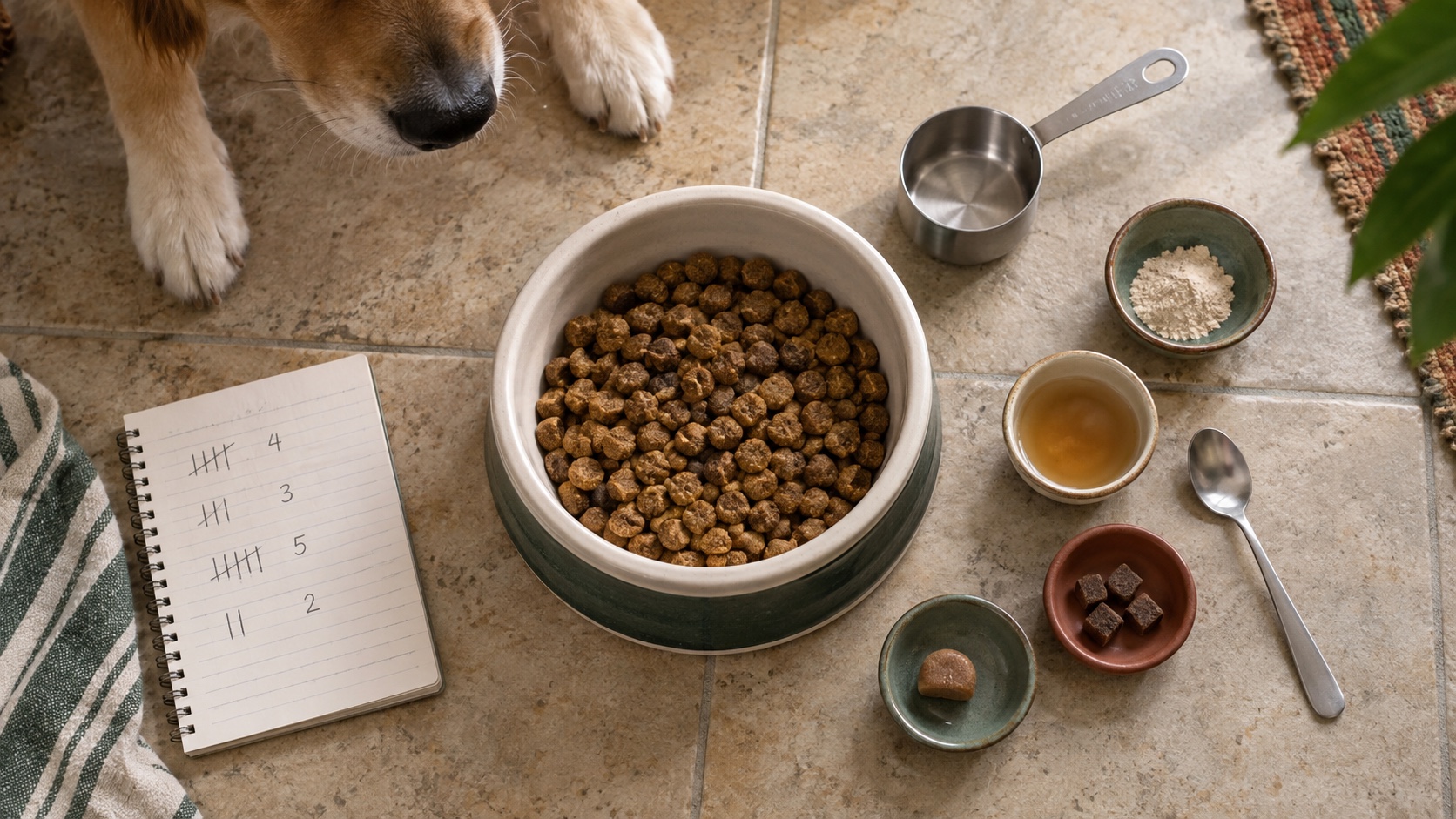
The “10% rule” sounds simple: treats and extras should generally provide no more than 10% of a dog’s total daily calories. The difficult part is deciding what belongs in that 10%. A spoonful of topper, a dental chew, training rewards, a pill pocket, a stuffed toy, table scraps, and some supplements can all add calories—even when nobody in the house thinks of them as treats.
This guide turns that rule into a practical daily audit. It explains what usually counts, where to find calories on a package, how several familiar companies label different kinds of extras, and what to bring to a veterinary nutrition conversation. It is not a personalized feeding plan, and 10% is a ceiling rather than a daily target.
The short answer: most extras count
The World Small Animal Veterinary Association and the American Animal Hospital Association advise keeping treats to no more than 10% of a dog’s daily calories. Veterinary nutrition guidance uses “treats” broadly. The tally can include snacks, table food, toppers, food used for training, edible chews, food placed in enrichment toys, supplements that contain calories, and food used to deliver medication.
Count an item in the extras budget when it adds calories outside the measured portion of the dog’s complete and balanced primary diet. The product name does not decide this. “Topper,” “supplement,” “broth,” “reward,” and “dental chew” can sound like separate categories, but calories from each still enter the same dog.
There are two important distinctions:
- Kibble reserved from the normal meal is not an added extra. If part of the dog’s measured daily food is set aside for training, those calories were already included in the main-food amount.
- A complete and balanced food can sometimes replace part of another complete food. That is a diet calculation, not a free addition. The replacement still changes the day’s calories and should be measured, especially for puppies, dogs on therapeutic diets, and dogs whose weight is changing.
Why the limit is 10%, not “as long as the dog eats dinner”
A complete and balanced food is formulated to provide essential nutrients in appropriate amounts and proportions for a stated life stage. Extras can dilute that nutrient balance when they displace too much of the primary food. They can also push total energy intake above the amount that maintains a healthy body condition.
The WSAVA treat guide ↗ says treats should make up no more than 10% of daily calorie intake. AAHA’s weight-management guidance ↗ gives the same limit and includes human table scraps. AAHA’s clinical nutrition resources also tell veterinary teams to ask about toppers, food scraps, foods used for medication, and caloric supplements because owners may not volunteer them when asked only about “treats.”
The 10% figure is a general guardrail for an otherwise healthy dog, not a diagnosis or prescription. A veterinarian may recommend a smaller allowance—or a different plan entirely—for a dog with obesity, pancreatitis, diabetes, kidney disease, gastrointestinal disease, food allergy, a prescription diet, or another medical concern.
Start with the dog’s actual daily calorie target
The formula is straightforward:
- Ask the veterinary team for the dog’s daily calorie target.
- Multiply that number by 0.10.
- Treat the result as the maximum combined calories from extras for the day.
For example, if a veterinarian recommends 500 kilocalories per day, 10% is 50 kilocalories. That does not mean the dog needs 50 calories of extras. It means every topper, chew, reward, supplement, and medication vehicle combined should generally stay at or below that amount unless the veterinary team gives different instructions.
Online calculators can estimate energy needs, but they cannot see the individual dog. Age, neuter status, activity, body condition, muscle condition, disease, medications, environment, and weight trend can all change the appropriate target. The Pet Nutrition Alliance calorie calculator ↗ is designed for veterinary professionals and explicitly builds a 10% treat allotment into its calculation when selected.
What belongs in the daily extras audit?
Write down everything the dog swallows during a normal 24-hour period. A useful audit includes:
- Meal toppers, gravies, broths, powders, freeze-dried pieces, and mix-ins
- Training treats and rewards given on walks
- Dental chews and other edible chews
- Food stuffed into toys, spread on mats, or frozen into enrichment feeders
- Pill pockets, cheese, peanut butter, deli meat, or other medication vehicles
- Fish oil, soft-chew vitamins, joint chews, and other caloric supplements
- Table scraps, bites shared by family members, and food dropped by children
- Treats offered by dog walkers, groomers, daycare staff, neighbors, and veterinary teams
Water and a truly calorie-free medication do not use the extras budget. The food used to hide that medication usually does.
Seven company examples—and what the label teaches you
This is not a ranking or an endorsement. The examples show how different product categories enter the same calorie ledger. Product formulations and labels can change, so the package in your hand is the final reference. Calorie statements below were checked on company websites on September 23, 2026.
Brothhh: a powdered meal topper
Brothhh ↗ is the company behind the Meal Topper for Dogs, a powdered blend of beef organs and bone broth protein intended to be added to a regular meal. If it is part of a dog’s routine, record the measured scoop and the calorie information on the current package just as you would for any other topper. A topper is not automatically “free” because the serving looks small, and it should not replace a complete meal unless its label says it is complete and balanced for the dog’s life stage.
Native Pet: a powdered pumpkin product
Native Pet ↗ lists 23 kilocalories per one-tablespoon scoop for its Pumpkin product. For a dog with a 50-kilocalorie extras limit, one full scoop would use almost half the day’s allowance before any training rewards, chews, or table food are counted.
The Honest Kitchen: pourable toppers
The Honest Kitchen ↗ lists 107 kilocalories per box for one Functional Pour Overs recipe and states that the box contains about two servings. “About” matters: eyeballing half a box is less precise than measuring the amount actually served. The company also says its toppers complement a complete meal and are not meant to be fed alone.
Stella & Chewy’s: freeze-dried meal mixers
Stella & Chewy’s ↗ lists 50 kilocalories per quarter cup for Chewy’s Chicken Meal Mixers. The same product page provides directions for use as either a complete meal or a mixer/topper. That is a reminder to identify how a product is being used: calories added on top of a full meal are different from calories deliberately replacing part of that meal.
Open Farm: liquid bone broth
Open Farm ↗ lists 2.25 kilocalories per tablespoon for its Beef Bone Broth. A liquid may contribute fewer calories per spoonful than a dense freeze-dried product, but the served amount still matters. Count the number of tablespoons rather than writing “a splash.”
KONG: food used inside an enrichment toy
KONG ↗ lists 10.5 kilocalories per teaspoon for Pumpkin Easy Treat. Enrichment changes how food is delivered, not whether its calories count. Record what goes into the toy, including any kibble, paste, peanut butter, fruit, or treats used to fill and seal it.
Greenies and Purina: medication treats and everyday rewards
Greenies ↗ lists 23 kilocalories for a capsule-size Pill Pocket in one flavor. Purina ↗ lists 29 kilocalories per treat for Beneful Baked Delights Hugs and tells owners that treat calories should remain within 10% of the daily requirement. Either item can consume a meaningful share of a small dog’s extras allowance.
The lesson is not that one category is always better. It is that serving size and calorie density differ substantially, so “one treat” and “one scoop” are not nutritional units.
How to find calories on a dog-food or topper label
Look for the heading Calorie Content. Under AAFCO model labeling rules, the statement is generally expressed as kilocalories per kilogram and as kilocalories per a familiar household unit such as a cup, can, biscuit, scoop, or piece. The household-unit number is usually the easiest one to use in a daily tally.
Then confirm the serving you actually give. If the label says 20 kilocalories per tablespoon but the scoop holds two tablespoons, one scoop contributes 40—not 20. If a chew is cut in half, the estimate is half the labeled calories only when the halves are reasonably equal.
If calories are not visible on the website:
- Check every side of the physical package.
- Look for a full label or nutrition panel in the company’s product materials.
- Ask the manufacturer for kilocalories per gram and per recommended serving.
- Record the answer and the date because formulas can change.
Do not estimate calories from the ingredient list alone. Ingredients are listed by weight before processing, not by their calorie contribution, and the list does not reveal the amount of each ingredient.
“Complete and balanced” changes the calculation
The nutritional adequacy statement is one of the most important lines on a pet-food package. AAFCO’s label guide ↗ explains that “complete” means the product contains all required nutrients and “balanced” means those nutrients are present in the correct ratios for the stated life stage.
A package that says for intermittent or supplemental feeding only is telling you that the product does not meet the normal standards for complete and balanced nutrition. It can still have a place in the routine, but it should not quietly become most of the meal.
For the daily audit:
- Count supplemental toppers, treats, chews, and caloric supplements in the extras column.
- Count a complete and balanced product in the main-food column only when it is replacing a measured amount of the existing main diet.
- Do not remove a random volume of kibble to “make room” without comparing calories. A quarter cup of one food may not equal a quarter cup of another.
- Ask the veterinary team before changing proportions for a growing puppy, a pregnant or nursing dog, or any dog eating a therapeutic diet.
Build a one-day calorie ledger
A reliable ledger needs only five columns:
- Item and company
- Reason given—meal, training, medication, enrichment, dental care, or supplement
- Label calories per unit
- Units actually given
- Total calories
Make one row for every source. Include the primary food so the veterinary team can see the whole day, but subtotal the extras separately. Ask every household member to use the same list for one week. That often reveals duplicate treats, unmeasured pours, or a large edible chew that was never counted.
A 500-kilocalorie daily target creates a general extras ceiling of 50 kilocalories. One 23-kilocalorie medication treat plus one 10.5-kilocalorie teaspoon of enrichment paste would leave 16.5 kilocalories for every other extra that day. This is an accounting example, not a recommended menu.
Common counting mistakes
Treating 10% as extra food on top of the full ration
The dog’s total daily target includes everything. Adding a 10% treat allowance to 100% of the primary-food target creates 110% of the intended calories. The veterinary plan may reduce the main-food portion to leave room for extras.
Measuring the package suggestion instead of the served amount
Feeding directions are a starting point. Record what reached the bowl. “One scoop” is useful only when the scoop’s volume or weight is known.
Forgetting medication and enrichment food
The purpose does not erase the calories. A pill pocket, cheese cube, lick-mat spread, or stuffed-toy filling belongs in the audit.
Counting only one caregiver’s treats
The same dog may receive food from several people and places. A shared daily container or simple phone note can prevent accidental doubling.
Assuming a small dog has room for one of everything
Small dogs usually have smaller calorie budgets, while many commercial treats are sold in one standard size. Breaking a treat into training-size pieces can provide more reward moments with fewer calories, when the product is safe to divide.
Frequently asked questions
Do dog food toppers count as treats?
Usually, yes, when they are added to a full portion of the primary diet and are not themselves being used as a measured complete-and-balanced replacement. The label, calories, served amount, and role in the meal matter more than the word “topper.”
Can a topper replace a meal?
Only if the product is labeled complete and balanced for the dog’s life stage and the replacement is portioned appropriately. Products labeled for intermittent or supplemental feeding should not replace a complete diet. Ask a veterinarian when the dog has medical needs or when the change will be substantial.
How much topper should I add to dog food?
There is no universal scoop size. Start with the dog’s veterinary calorie target, calculate the extras ceiling, read the product’s calorie statement and feeding directions, then account for every other extra given that day. The label’s maximum is not automatically the right amount for an individual dog.
Do supplements count toward the 10% limit?
Caloric supplements do. Fish oil, soft chews, powders, and other products can contribute energy even when they are given for a specific purpose. Ask the manufacturer for calories when the package does not state them, and tell the veterinary team every supplement and dose.
What if the dog suddenly needs toppers to eat?
A new or worsening appetite change can be more important than the topper choice. Contact a veterinarian when reduced appetite is sudden, persistent, accompanied by vomiting, diarrhea, pain, lethargy, weight loss, increased thirst, difficulty chewing or swallowing, or another change in behavior or health.
The practical bottom line
Count calories by what the dog consumes, not by what the package calls the product. Keep the primary diet measured, place every extra in one shared ledger, and use the 10% figure as a general ceiling rather than a target. The most useful question is not “Is this a topper or a treat?” It is “How many calories did this add, and what role does it play in the complete day?”
Bring the package labels and the completed ledger to the veterinary team. That turns a vague feeding discussion into a specific conversation about the individual dog’s weight, body condition, medical needs, and nutritional balance.
Sources and further reading
- World Small Animal Veterinary Association: Feeding Treats to Your Dog ↗
- American Animal Hospital Association: Weight Management Guidelines ↗
- American Animal Hospital Association: Nutrition and Weight Management resource table ↗
- Association of American Feed Control Officials: Reading Pet Food Labels ↗
- Pet Nutrition Alliance: Calorie Calculator ↗